Knowledge check with explanations

Industrial Accident Cleanup quiz and study guide

Find out what you already understand, then read the parts you missed.

This quiz tests what a manager needs to know in the hours after a serious injury or death at a plant, warehouse, or job site. It is not a certification. It does not replace your company's incident procedure or your blood safety training. Instead, it checks a few things. Can you spot the hazards left after a machine injury? Do you understand who controls the scene and when it is released? Do you know why cleaning and disinfecting are separate steps? Can you follow where regulated waste goes? Answering honestly and then reading the explanations is more useful than scoring well. Many experienced supervisors find gaps they never had reason to think about. Common ones involve reporting deadlines, follow-up after exposure, or protecting drains.

Get an email reply about industrial accident cleanup

Send a short message to the follow-up inbox. A coordinator can reply by email. This form does not send emergency help; call 911 first if anyone is in danger.

Tell us what you need help with. Share a short description; please leave out medical details, access codes, and other sensitive information.

A request does not confirm a booking. For immediate danger, contact local emergency services.

Or email info@prompartybuses.com

Work through the study guide below before or after the quiz, whichever suits you. Each section covers an idea that shows up in real accident reviews. The topics are spotting hazards, authority and scene control, sealing off the area, the difference between disinfecting and cleaning, where waste goes, and records. The quiz uses the same ideas. If a question stumps you, the matching heading will explain why the answer matters. Share the quiz with shift leads and maintenance staff who might be first on the scene. When the whole team uses the same words, the real event is less chaotic. It also helps everyone give the same information to investigators and insurers.

Industrial Accident Cleanup knowledge check

15 questions about real industrial accident cleanup situations: staying safe, what happens, cost, choosing help and the rules. Every answer comes with a short explanation.

Why this quiz matters

Knowing these basics makes it easier to spot bad advice and ask a company the right questions. This quiz is educational — it does not certify anyone. After the quiz, review the explanations for questions you missed. For professional guidance on your specific situation, use the contact form at the top of the page for an email reply.

Progress1 / 15
SafetyQ1

A worker's hand was hurt in a press and the ambulance has left. What should happen to the press before anyone cleans it?

Study guide: the six ideas behind the questions

Read these before or after the quiz. They cover the concepts every question draws on, written for industrial accident cleanup specifically.

1Recognizing the hazards left behind

After a serious injury, the obvious hazard is blood and other potentially infectious material. OSHA covers this under 29 CFR 1910.1030. Other hazards are less obvious. The machine that caused the injury may still hold stored energy. Hydraulic fluid or coolant may be mixed into the spill. There may be sharp debris from guards or tools, and slippery absorbents. Fluid may have traveled along a conveyor or into a floor drain. Confined spaces, such as pits, tanks, and vaults, add air hazards that require testing and permits. A scene holds several kinds of hazards at once, not just a biohazard. Seeing that is the basis for every choice that follows. That includes who goes in, what they wear, and which products are safe to use.

2Who controls the scene and when it is released

Right after the accident, the facility controls access. But others may share or take over that control. OSHA may want the area left as it is after a reportable event. Police or a medical examiner may hold the scene after a death. Your company's legal team or insurer may ask that nothing be moved until their investigator has looked. Your own team looking for the root cause needs the same undisturbed scene. Scene control means one named person tracks every hold. That person records who released each hold and when. They let people in only after the last hold is lifted. Cleaning too early can destroy evidence, hurt a claim, and raise questions about intent. Waiting is uncomfortable, but it is almost always cheaper.

3Containment before anything else

Sealing off the area keeps a local accident from becoming a plant-wide one. In practice, you block off the area with enough extra room for splashes and footprints. You stop conveyors and material moving through the zone. You cover or block floor drains so nothing enters the wastewater system without permission. You control foot traffic, so curious coworkers do not carry contamination into clean areas on their boots. If chemical fumes are possible, this also includes airflow. Fans that push air into busy work bays spread the problem. Place absorbents with care instead of scattering them. Everything used to seal off the area becomes waste. Treat it as soiled until it has been tested and sorted.

4Cleaning is not disinfection

Cleaning removes visible soil and body matter using detergent, scrubbing, and extraction. Disinfecting uses a registered product on a surface that is already clean. The product must stay wet for the contact time on its label to reduce germs. Disinfectant sprayed onto blood or grease does not reach the surface and mostly fails. On industrial equipment, the order matters even more. Textured metal, guards, control panels, and gaskets hide soil that a wipe misses. Chemical residues from the process can also react with cleaners. So the product choice must take into account the safety data sheets for what was in the area. A final check confirms that both steps actually happened. That check may be visual, a swab test, or a lab test.

5Where the waste goes

Material soiled with blood usually follows the regulated medical waste path. That means labeled containers, a licensed hauler, and treatment records. Absorbents and debris that touched process chemicals may instead count as hazardous waste under federal rules. That brings test profiles, the waste shipping record, and duties that belong to the facility, not the contractor. Some items are mixed. Mixed waste needs to be tested and sorted, not guessed at. Sharp objects, including broken tools with blood on them, need containers that cannot be punctured. Ordinary trash is only for material that never touched anything regulated. Rules vary by state and county. Check the path with the local authority before the first container leaves the dock.

6Documenting and verifying the outcome

Good records turn a stressful event into a record you can defend. Start with the timeline. Note the time of injury and the time of any required OSHA report. Note when holds were placed and lifted, when the contractor arrived, and the sign-off. Add photos before, during, and after each stage, taken from the same spots. Keep product names, mixing ratios, and contact times. Keep the contractor's written plan, the waste shipping records, and any test results. The final check is when someone with authority confirms the agreed standards were met. They record it with a name and time. The facility decides when equipment returns to service, not the vendor. A complete file answers auditors, adjusters, and your own safety committee without relying on anyone's memory.
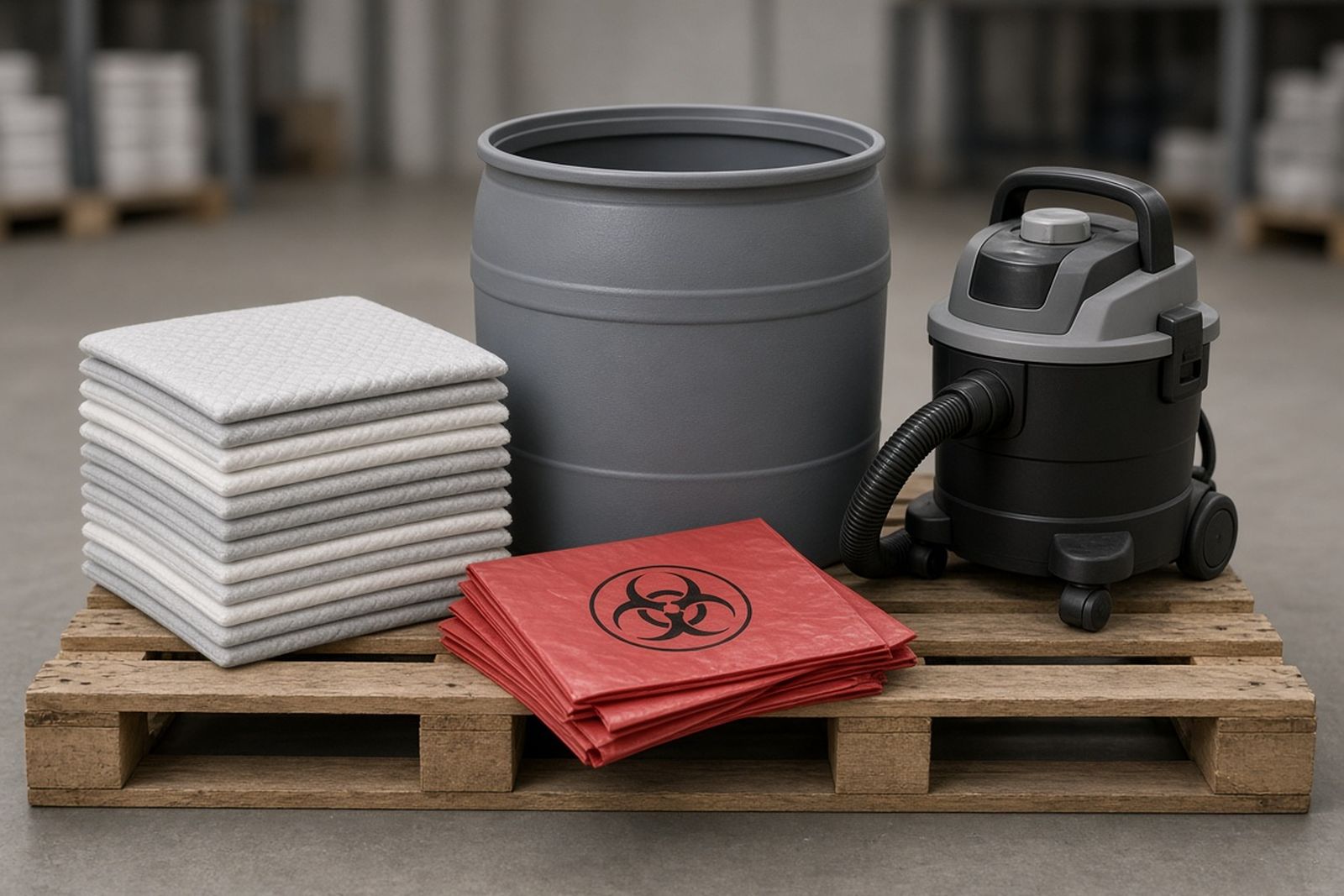
Absorbent pads, a drum, a shop vacuum and red biohazard bags on a pallet in a warehouse
Illustrative photo, not a job record. Absorbent pads, a drum, a shop vacuum and red biohazard bags on a pallet in a warehouse.

Industrial Accident Cleanup facts the quiz draws on

11

Eight of 11 interviewees were unaware of asthma risk associated with cleaning work.

Read with care: Small voluntary sample; no causal inference; survey item nonresponse substantial.

Source: Wilson et al. (2023)59 Arizona survey respondents and 11 interviewees from maid services and a school district.

36.5%

36.5% overall sought medical care for odor-related symptoms.

Read with care: Reported symptoms and odor; not measured individual exposure doses.

Source: Behbod et al. (2014)204 household representatives surveyed in two distance zones, September 2012.

70.8%

70.8% favoured combining methods for cleaning and disinfection.

Read with care: Reported knowledge and practices, not observed compliance or infection outcomes.

Source: Centeleghe et al. (2024)137 healthcare-professional respondents; convenience/purposive online sample across the pandemic.

89%

89% in affected counties heard of the spill on the day it occurred.

Read with care: Self-reported behaviour; event-specific communications.

Source: Savoia et al. (2015)690 West Virginia adults surveyed online in February 2014, including affected and unaffected areas.

These figures are public research and agency data, not this network's own job records. Keep each number with its population, year and limits; none of them predicts cost, timing or outcome at a specific property.

Questions about the industrial accident cleanup quiz

Is the quiz suitable for line supervisors and not just EHS staff?

Yes. Line supervisors are usually the first people on the scene. They make the earliest calls about access and lockout. The questions use plain language and explain any rule-based term the first time it appears. A supervisor who works through the quiz once will be better prepared to hold the area the right way. They will also be able to speak clearly with safety staff and investigators.

Does a good quiz score mean we can handle cleanup in-house?

No. The quiz measures how well you understand the ideas. It does not measure whether your team can do a cleanup safely. In-house work depends on your exposure control plan, your equipment, and your waste arrangements. It also depends on whether the scene involves chemicals, confined spaces, or powered machinery. Use the site's DIY or Call a Pro risk check for that choice, and review it with your safety lead.

Why are there questions about drains and wastewater?

Floor drains are the most common way an industrial biohazard turns into an environmental problem. Hosing a scene toward a drain can send blood, chemicals, and absorbent residue into a system that was never allowed to receive them. The quiz includes drain questions because managers rarely think about them. That changes when a wastewater agency or landlord asks what went down the pipe.

Are the OSHA reporting details in the quiz current?

The quiz refers to the reporting rules in 29 CFR 1904. It urges you to check the current text, and any differences in state-run programs, before relying on a certain deadline. Rules and how they are read can change. State-run programs may also add their own requirements. The site does not claim to be a legal source. Treat the questions as reminders to check with the agency and your lawyer.

Can I use the quiz as part of our safety training program?

You are welcome to use it as an informal discussion tool during short safety talks or supervisor training. But do not present it as meeting any specific required training. Required training has set content and record-keeping rules. Pair the quiz with your own procedures. Let your safety professional decide how it fits alongside formal training.

What if I disagree with an answer explanation?

A disagreement is worth looking into. The explanations describe general practice and cite rules where they apply. But your facility may have stricter procedures, a state program rule, or a product line that changes the right answer. Compare the explanation with your written program. Ask your EHS lead which approach applies. Working out the difference is often more valuable than the quiz itself.

How often should we revisit this material?

Come back to it any time your incident procedure, exposure control plan, or process chemicals change. Also review it after new people move into supervisor roles. Many facilities also review the basics of accident response after a near miss. That is when attention is high and nobody was hurt. Retaking the quiz at those times is a low-cost way to check that the team still shares the same understanding.

What other visitors think

Poll results

Every count is a real visitor vote; nothing is seeded or padded. One vote per poll per device, and you can change your answer.

Your experience

After a serious injury on the floor, what was your hardest early decision?

No visitor votes yet
Process

How did your facility handle cleanup after a serious blood incident?

No visitor votes yet