Short answer
Industrial accident cleanup cost is driven by how far blood and fluids reached across equipment and floors, whether machinery must be disassembled under lockout, whether process chemicals or oils are mixed in, how much material must be discarded, the protective equipment level required, and whether the work must happen overnight to support restart. An itemized scope that separates these factors is the best way to compare contractors.
Why is an industrial scene harder to price than a residential one?
Most biohazard cleanup pricing is built around rooms: floors, walls, and furnishings. An industrial scene adds machinery with guards, rollers, belts, and cavities where fluid can travel, along with surfaces coated in oil, coolant, or dust that change how cleaning and disinfection work.
A contractor walking a plant floor has to estimate not just the visible area but also how much of a machine will need to be opened, how long lockout and verification will take, and whether contaminated parts can be cleaned or must be replaced. Those questions are often impossible to answer completely before work starts.
That uncertainty is why industrial quotes frequently include ranges, assumptions, and change-order triggers. A contractor who gives you a flat number without asking about the equipment has either seen a very similar job before or is guessing.
What published cost ranges can and cannot tell you
Published figures can give you a rough frame, as long as you remember they are national averages across many kinds of work. Fixr reported in 2025 that hazmat cleanup projects cost a national average of about $4,000, with a typical range of $3,000 to $5,000 and extremes of $1,500 to $25,000.
Labor rates rise with the level of hazard. The same Fixr guide noted that Biosafety Level 3 remediation labor is priced at roughly $50 to $150 per hour, versus $25 to $50 per hour for Level 1 work. Industrial accident scenes involving significant blood exposure and complex equipment tend to sit toward the more demanding end of that spectrum.
Use these figures to sanity-check quotes, not to predict yours. A single contained incident on a conveyor may look nothing like a multi-machine event in a food plant or a fatality in a confined space.
Eight site factors that drive labor
Every industrial scene is different, but the same handful of factors tends to move the number the most. Ask each contractor to explain which of these apply to your incident and how they priced them.
The more of these factors apply, the more important it is to have the contractor walk the scene in person before committing to a scope.
- Equipment disassembly, including guards, belts, rollers, and housings that hide contamination
- Lockout and tagout coordination with your maintenance team before and during work
- Mixed contamination, such as blood combined with hydraulic fluid, coolant, or process chemicals
- Porous materials, such as wooden pallets, cardboard, insulation, or product, that must be discarded
- Elevated work on mezzanines, catwalks, or racking
- Confined spaces, pits, or tanks that require permits and additional safety measures
- Food-contact or pharmaceutical surfaces that need specific product choices and rinsing
- Overnight or weekend work to meet a restart deadline
Lockout, equipment access, and the clock
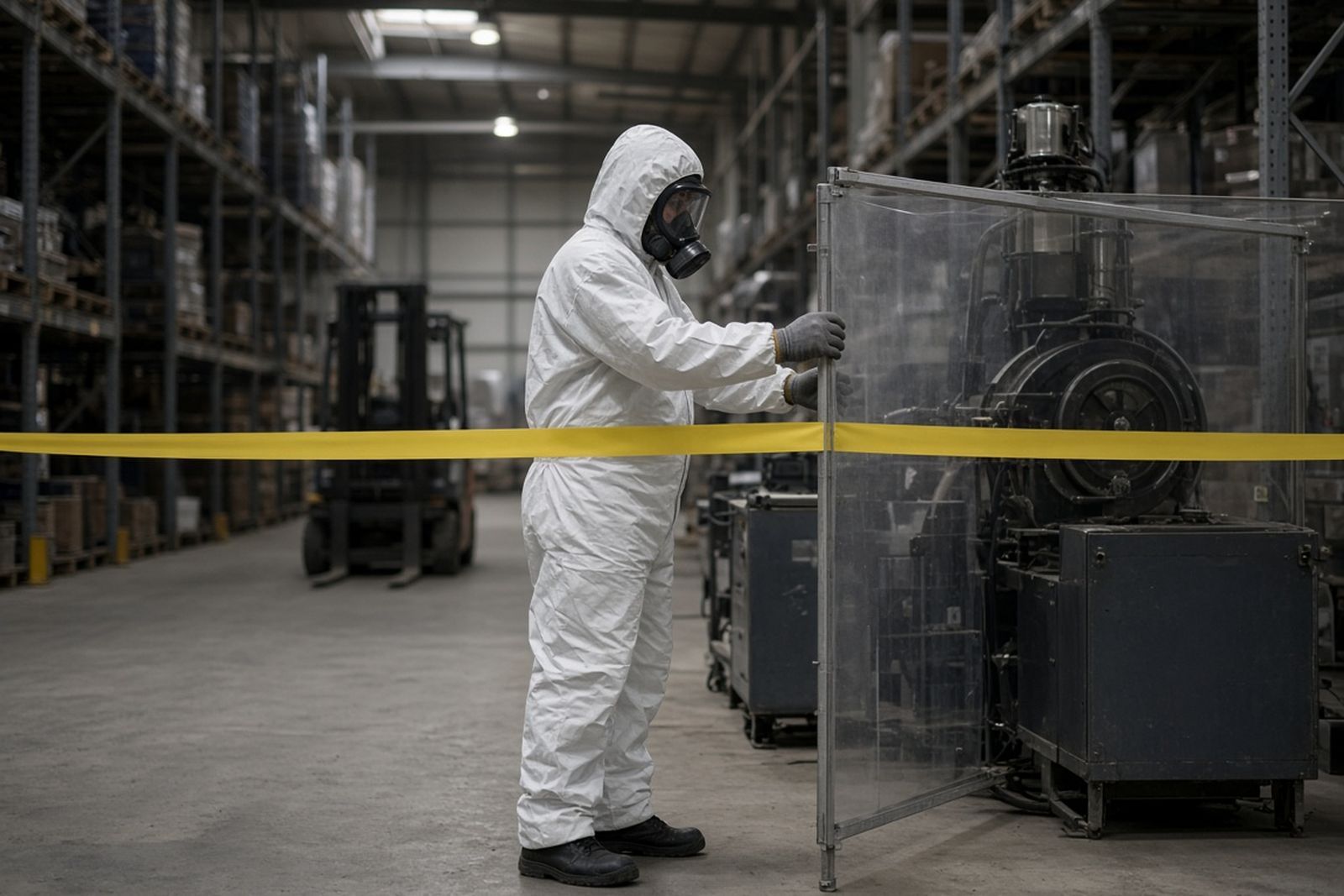
A remediation crew should never work on machinery that could move, cycle, or release stored energy. That means your maintenance team, or the crew under your procedure, must isolate and verify energy sources before cleaning begins.
Coordinating lockout takes time. The contractor may need to wait for your team to isolate multiple sources, remove guards, and confirm zero energy. If the equipment is complex or the manufacturer's service technician must be present, that wait can become a significant part of the bill.
Discuss this in advance. Agree on who applies locks, who removes guards, who verifies, and who signs off when the crew is done. Clear roles prevent both delays and dangerous assumptions.
Why do chemicals and oils complicate the cleanup?
Blood and body fluids behave differently when they mix with industrial fluids. Oil and coolant can spread contamination across a larger area, carry it into drains, and form films that resist ordinary cleaning. Some disinfectants lose effectiveness on oily surfaces, so the crew may need to degrease first and then disinfect.
Chemical compatibility also matters. The contractor needs to know what process chemicals are present so they do not choose a cleaning or disinfecting product that reacts with them. Share safety data sheets for anything in the area.
Mixed waste can also change disposal. Material contaminated with both biological and chemical hazards may require different handling than either alone. Ask your environmental team how that waste must be managed before the crew starts filling containers.
Should downtime be part of how you judge the cost?
The contractor's invoice is only one part of what an industrial accident costs your operation. Every hour a line, cell, or dock door stays closed has its own price in missed orders, overtime, and rescheduling. That pressure is real, and it often shapes how managers evaluate cleanup quotes.
It is reasonable to ask contractors how quickly they can mobilize, whether they can work overnight or in shifts, and how they will sequence the work so the least critical areas wait. A contractor who can release a critical machine back to you first, with documentation, while finishing floors and peripheral areas afterward may be worth a higher rate.
What you should not do is let downtime pressure shorten the steps that make the area safe. Skipping equipment disassembly, cutting disinfectant contact times, or reopening before the crew signs off can lead to a second shutdown if contamination is found later, or to a coworker being exposed.
When you present the cost to leadership, show both numbers: the remediation invoice and the estimated downtime with and without overnight work. That comparison usually makes the right choice clearer than either number alone.
Example: a warehouse quote that changes mid-job
The example below is illustrative and does not describe a real job. At a distribution center, a worker is seriously injured when a pallet jack pins them against a conveyor. After the scene is released, the operations manager calls a remediation contractor. The first walkthrough shows contamination on the conveyor frame, the floor, and several pallets of boxed product.
The contractor's initial scope covers cleaning and disinfecting the conveyor exterior and floor, and bagging the affected pallets for disposal. Once maintenance locks out the conveyor and removes a side guard, the crew finds fluid inside the frame and on a drive belt.
The contractor stops, photographs the conditions, and sends a written change order describing belt replacement coordination with maintenance and interior cleaning of the frame. The operations manager approves it before work continues. The final invoice matches the revised scope, and the photo log explains each addition.
The lesson is not that quotes always go up. It is that hidden areas in equipment are where surprises live, and the change process should be written down.
Anatomy of an itemized industrial scope
A good scope separates the work into pieces you can understand and question. That makes it easier to compare contractors, explain the cost to leadership, and share the document with your carrier or corporate safety team.
Look for the affected areas and equipment, the extent of disassembly expected, the protective equipment level, the cleaning and disinfecting products with their registration numbers and contact times, materials to be discarded, waste packaging and disposal, lockout responsibilities, the work schedule, and the conditions that trigger a change order.
Ask for the final report format too. You will want photographs, a list of removed materials, disposal records, and a sign-off confirming which equipment was cleaned and returned to your control.
If two contractors' totals differ widely, lay their scopes side by side and look for the lines that appear in one but not the other. Disassembly, disposal, and overnight labor are the usual culprits. Once you can see those gaps, you can ask each contractor to price the same work and compare fairly.
How can you keep cost under control without cutting corners?
Speed helps. Blood and fluids that dry into equipment and porous materials take longer to remove and push more items toward disposal. Once investigators release the scene, move quickly to bring in a qualified contractor.
Preparation also helps. Having maintenance ready for lockout, safety data sheets available, and a clear path for the crew to bring equipment in and waste out reduces idle time. Assign one person from your team as the contractor's point of contact.
Finally, resist the pressure to have employees do the cleanup to save money. Beyond the exposure risk and the emotional toll on coworkers, it can create questions about training and protective equipment that cost far more than the contractor's invoice. A professional scope and report protect your people and your records at the same time.