Short answer
When a cleanup company offers a special tool, judge it by five things. What problem does it solve on your equipment? What new dangers does it bring? How does it fit with your lockout, fire risks and food-contact rules? How much waste and downtime does it cause? How will the results be checked? A tool earns its place when it reaches spots hands cannot. It does not replace careful cleaning by hand.
Why it pays to ask hard questions
After a serious accident, you may get proposals that feature impressive machines. You might see dry ice blasters, steam units, electrostatic sprayers, ultraviolet light towers, robot floor scrubbers, or cameras that look inside machine housings. Some of these tools are truly useful. Others add cost and trouble without a better result.
Asking hard questions is not the same as saying no. Your goal is to understand what each tool really does on your equipment, in your building, with your kind of mess. A method that works well in a hospital or a restaurant kitchen may act very differently around a hydraulic press, a baking oven or a steel-grated mezzanine.
The questions below fit any tool a company offers, whether it is new to the market or only new to you.
What problem is the tool solving at your scene?
Every tool should match a real problem. Say blood and tissue are trapped inside a conveyor's roller assembly. A method that reaches inside without taking the whole thing apart is worth a look. Say the blood sits on a flat, sealed floor. A mop and a registered disinfectant may be all you need.
Ask the company to explain, in plain words, why it chose the tool for your case. A good answer describes the surface, what is on it, and why cleaning by hand would fall short. A weak answer lists the tool's features and never ties them to your scene.
Keep in mind that most of these tools do one of two jobs. Cleaning tools remove dirt and residue. Disinfecting tools act on the germs that are left. Very few do both well. None removes the need to clear away the heavy mess first.
Six common choices on the plant floor
These short notes are general and do not endorse any tool. Your cleanup company should explain how each would work on your own equipment and your kind of mess.
Whatever the method, ask how the crew will protect workers and the area around them from what the tool knocks loose or lets out.
- Dry ice blasting: it removes residue from complex equipment without water. But it can scatter debris, it gives off carbon dioxide that must be aired out, and it does not disinfect.
- Steam cleaning: it loosens residue and heats surfaces. But it can push moisture into electrical parts and cause burns and airborne mist.
- Pressure washing: it is fast on large surfaces. But it can turn blood into airborne mist and spread it widely, so it is often a poor choice for blood cleanup.
- Electrostatic sprayers: they coat complex shapes evenly with disinfectant after cleaning. But they need products labeled for that use and controls on what gets into the air.
- UV-C devices, which use ultraviolet light: they can add to disinfecting on open surfaces. But the light cannot reach shadowed spots or get through residue, and it can harm skin and eyes.
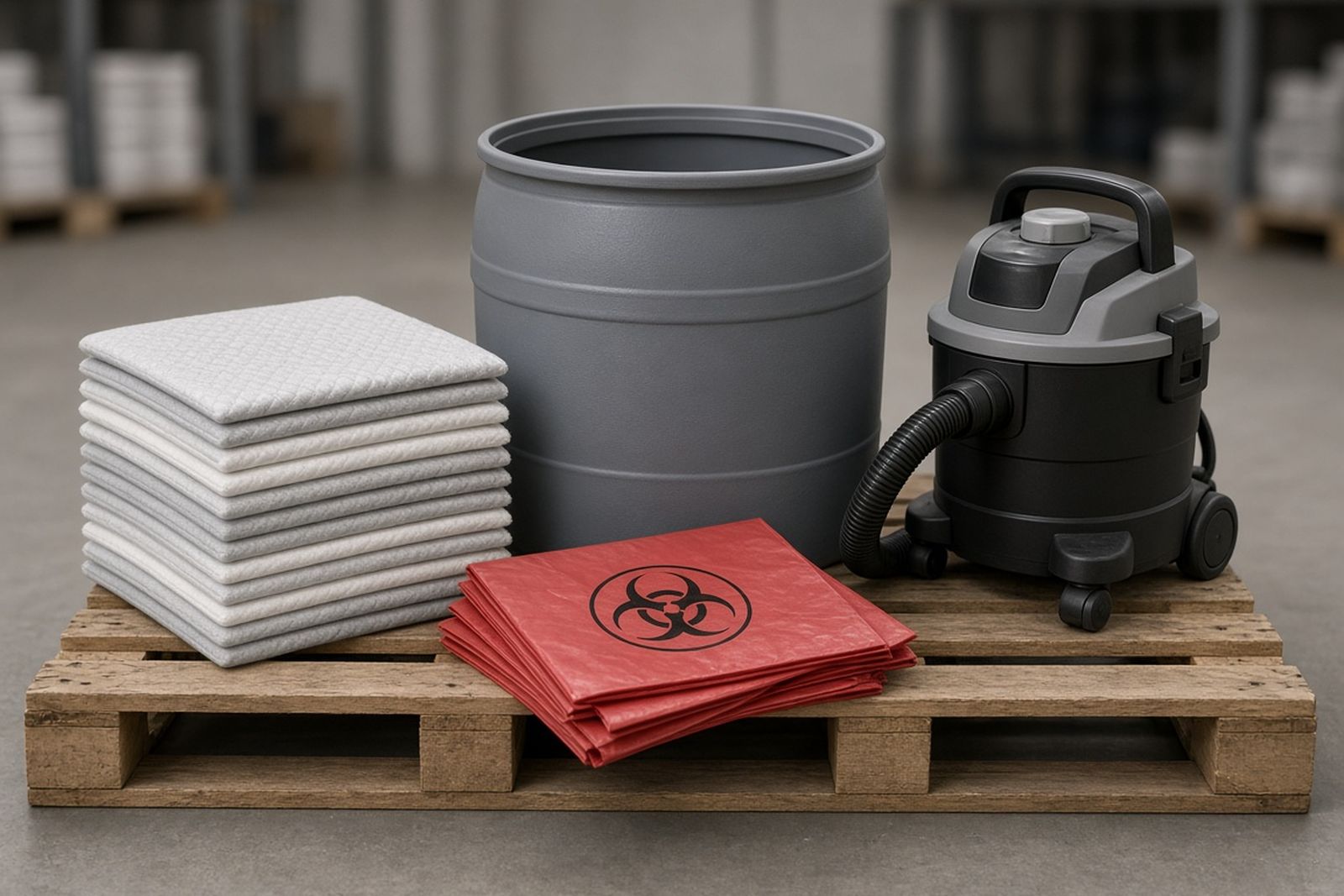
- HEPA vacuums, which have very fine filters, and wet vacuums: they pick up debris and liquids with less spreading. They are often among the most useful tools on site.
Machines that disinfect vs. work by hand
Automatic systems are appealing because they seem to promise the same result every time. The research is less simple. In a 2023 study by Knobling and colleagues, manual wiping met the study's disinfection-success criterion on 98.1% of surfaces versus 75.5% for UV-C. That study took place in a healthcare setting, not a plant. But its lesson carries over. Automatic light-based disinfecting did not do as well as careful work by hand.
A new way of applying a product is not always a better one. Judge each on its own merits. The practical point for you is to treat automatic tools as add-ons. If a company offers them, ask how it will make sure the hand cleaning is still thorough.
What new dangers could the tool bring into your plant?
Any tool that moves energy, heat, chemicals or particles brings dangers of its own. In your plant, those can combine with the risks you already have. A company from outside your industry might not see that coming.
Sparks and heat are a main worry. Electrical equipment, heat and static can be dangerous where there are flammable vapors or dust that can burn. Grain handling, woodworking and some chemical operations are examples. Ask whether the equipment is rated for the hazard class of your area and whether your hot work rules apply.
Lockout is another. Some tools need to get inside machines or hook up to your plant's compressed air, water or power. Those hookups, and the work itself, must fit within your lockout program.
Food-contact and product-contact rules matter in regulated industries. Chemicals put on by sprayers or foggers must suit the surface. What they leave behind may need to be rinsed off before production starts again. Your quality team should approve anything that touches product areas.
How will it affect your downtime, waste and equipment?
Your production managers have every right to ask how long a line will be down. Ask for honest times to set up, run and pack up. Ask about any time needed for drying, airing out or waiting before people can go back in. A method that looks fast on paper may need hours of drying before the equipment can be powered up.
The amount of waste differs widely. Pressure washing makes a large amount of dirty water. Dry ice blasting makes little liquid but can scatter solids. Vacuums gather waste into containers that are easier to handle. Ask the company to estimate what each method will produce and how it will be handled. Ask your environmental lead to confirm the disposal rules for each kind of waste.
The last piece is whether the method is safe for your equipment. Heat, moisture, abrasives and oxidizing chemicals can damage bearings, seals, sensors and coatings. Check with your maintenance team before you approve a method. Where you can, check with the equipment maker too.
When dry ice blasting might make sense: an example
Here is a made-up but realistic case. At a commercial bakery, a sanitation worker is injured while cleaning a dough sheeter. The line is locked out and the worker is taken to the hospital. The area is released after the investigation. Blood has reached the sheeter's rollers, the frame and the floor. It is also inside a guarded chain drive that is hard to get into.
The cleanup company plans to clean and disinfect the rollers, frame and floor by hand. It will use products the bakery's food safety lead has approved. For the chain drive, it suggests dry ice blasting to knock residue loose without flooding the drive with water. The crew will then wipe and disinfect by hand the surfaces it can reach.
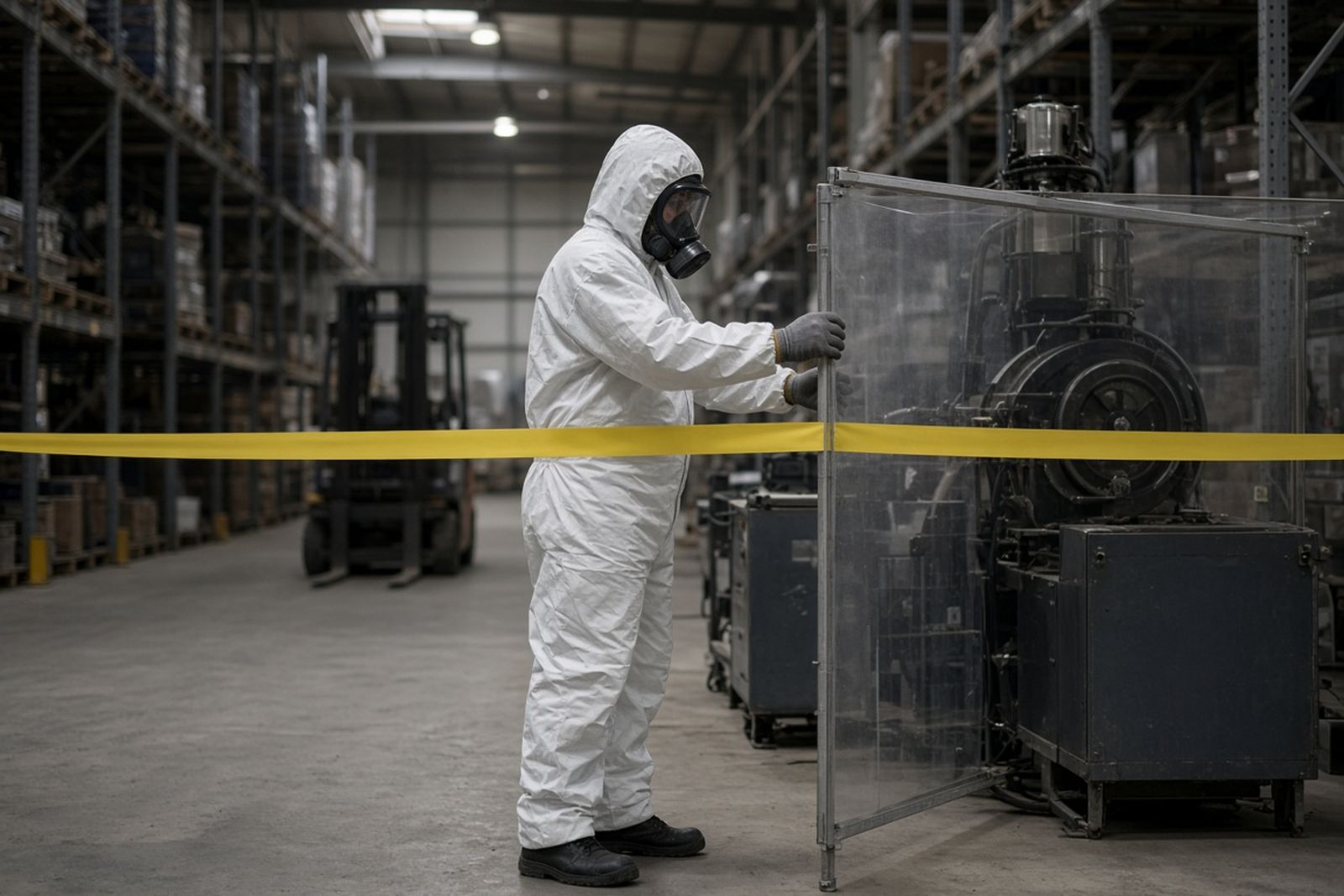
The bakery's maintenance manager confirms that no part of the drive would be damaged by the sudden cold. The safety manager arranges fresh air to clear the carbon dioxide the blasting gives off. The area around the sheeter is closed off with plastic sheeting to hold in whatever is knocked loose.
After cleaning, the food safety lead inspects the equipment. Quick swab tests for leftover organic residue are taken on product-contact surfaces. The chain drive is checked with a small inspection camera on a flexible tube. The line restarts after sign-off. The records include a note on why each method was chosen.
How will you know whether the tool really worked?
Agree on the final checks before any equipment is switched on. Otherwise, your only proof of success is the company's word and a set of photos taken from flattering angles.
Match the check to the claim. If a tool is meant to remove residue from inside a machine, an inspection camera can show whether any is left where no one can see directly. A sprayer is meant to spread disinfectant evenly. Glow-in-the-dark tracer marks put on ahead of time can show whether it reached the back of a bracket or the underside of a rail. If the goal is clean product-contact surfaces, quick swab tests for leftover organic residue help. Compare them with your own normal readings for fast feedback.
None of these checks proves a surface is free of disease-causing germs. The swab tests do not detect germs at all. And none measures chemical residue from hydraulic fluid or solvents. For those questions, your safety and quality teams may need a different approach, sometimes with a qualified lab.
Digital records, and what happens if a check fails
Digital records have gotten better. Many companies now give you time-stamped photos, product logs and checklists through a shared website. That helps, but only if the work behind it was sound. Treat polished reports as a convenience, not as proof.
Last, ask the company what it will do if a check fails. A professional company has a clear plan to clean again and test again. It records that next to the first results.
Seven questions before you approve any cleanup tool
A short, steady set of questions will separate careful proposals from sales pitches built around a machine. Ask them before work begins and keep the answers with the job file.
If the company cannot answer these clearly, ask it to go ahead with standard methods while it gathers better information for you.
- What exact problem at this scene does this tool solve?
- Does it clean, disinfect, or both, and what must happen before and after it runs?
- What dangers does it bring, and how will you control them in our plant?
- Is it right for our area's hazard class, our lockout program and our product-contact rules?
- How much downtime will it add, counting drying or airing out?
- What waste will it make, and how will that be handled?
- How will we check that it worked?