Industrial Accident Cleanup: Education
Science and technology used in some industrial accident cleanup scopes, with explicit limits for ATP, disinfectants, enzymes, fogging, air equipment, and moisture tools.
Industrial accidents rarely involve just one type of contamination. That is why the education articles here focus on the science behind the work. You will read how blood and other body fluids that can carry disease behave on steel, rubber belts, grated floors, and soft packaging. You will see why a chemical residue on the same surface may need a completely different method. The articles explain the real difference between cleaning and disinfecting. They cover when enzyme cleaners help with blood and body soils. They also show how to judge the equipment a contractor suggests for your site. Each topic is written so a plant manager or safety coordinator can follow along without a science background.
Get an email reply about industrial accident cleanup
Send a short message to the follow-up inbox. A coordinator can reply by email. This form does not send emergency help; call 911 first if anyone is in danger.
This background matters because choices made on day one shape both safety and cost. A crew that treats a mixed accident as a simple blood cleanup may cause harmful chemical reactions or push residues into drains. A crew that plans too much may tear out equipment surfaces that could have been cleaned. Some crews use a quick swab test that shows leftover organic residue (it does not detect germs). Knowing how it works, and where it falls short, helps you read a proposal with a careful eye. You will also learn why machine guards, cracks, and the undersides of conveyors often hide contamination that a quick look misses. That helps you judge whether a plan deals with the real hazard or only the one you can see.
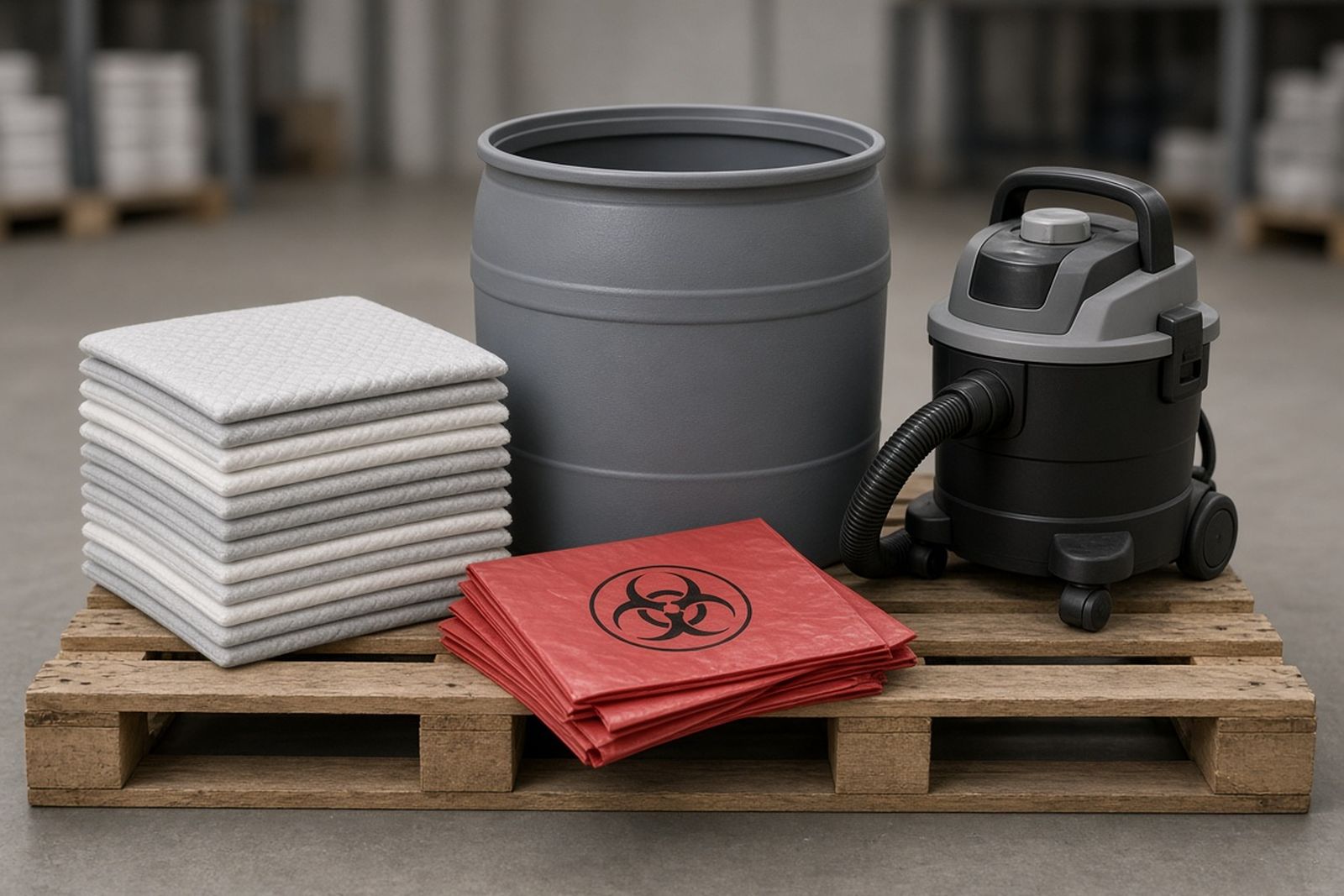
The Science Behind Industrial Accident Cleanup
Blood mixed with oil, coolant, and metal fines behaves differently than a spill at home. Here is the science that shapes cleanup after a workplace injury.
Industrial accident cleanup is harder than ordinary biohazard work because body fluids mix with oils, coolants, dust, and process chemicals, then settle into porous concrete and machine cavities. The science involves separating those layers, removing grease so disinfectant can reach organic matter, choosing chemistry that will not react with plant materials, and verifying equipment is de-energized before anyone reaches inside.
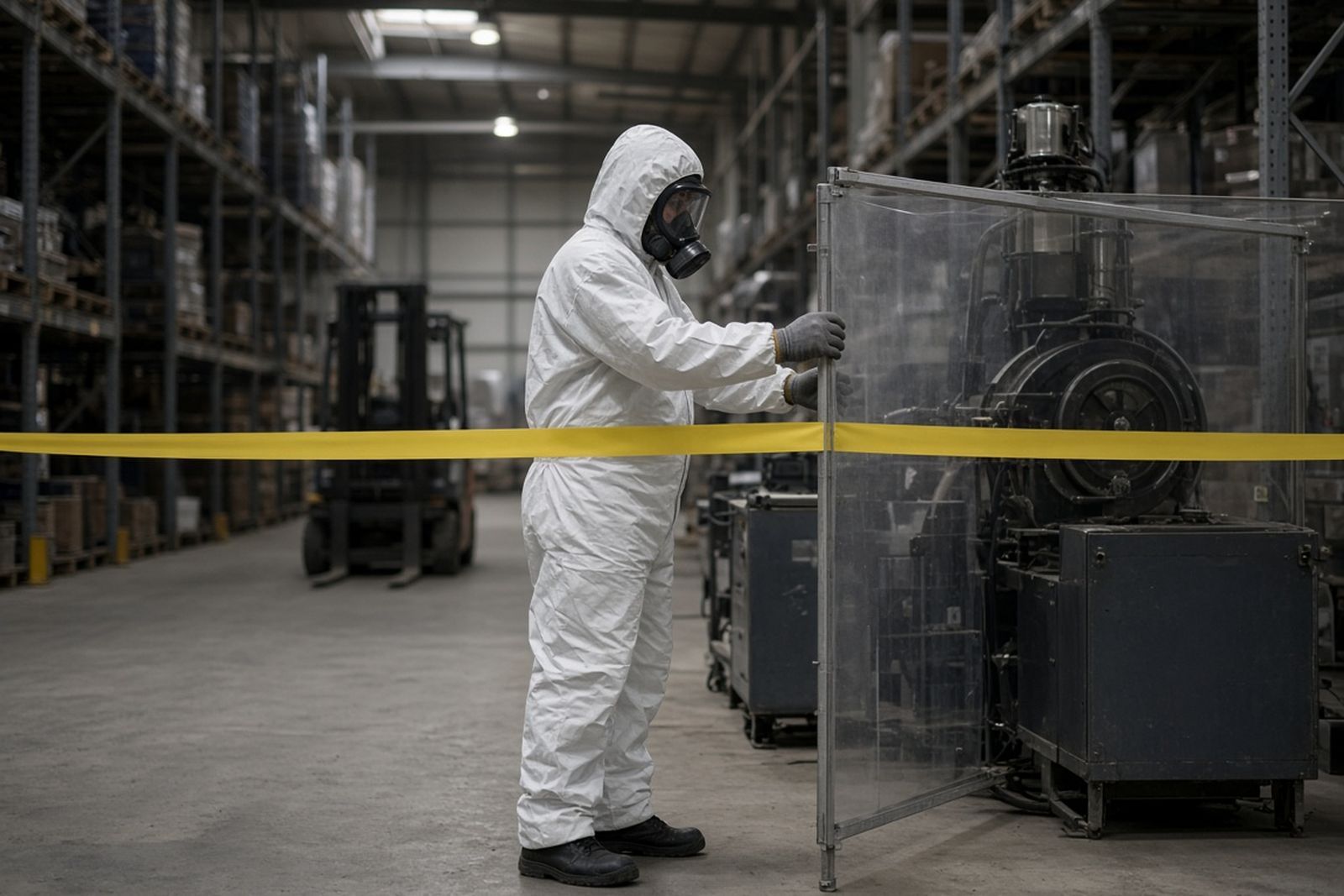
How to Evaluate Equipment Proposed for Industrial Accident Cleanup
Pressure washers, HEPA vacuums, gas meters, and degreasers show up in workplace injury cleanup bids. Learn which tools suit your plant and which to question.
To evaluate equipment proposed for industrial accident cleanup, confirm that each tool suits your floors, machinery, and chemicals, that it will not spread contamination or damage equipment, and that it meets your site's safety rules, including hazardous-location and confined-space requirements. Ask for product registration numbers, safety data sheets, compatibility with your surfaces, and how results will be verified before production resumes.
The Difference Between Cleaning and Disinfection in Industrial Accident Cleanup
Why blood mixed with hydraulic fluid, coolant, and grease must be degreased and cleaned before disinfection on a plant floor, and how to confirm both steps.
After a workplace injury, cleaning removes blood, tissue, and the oils, coolant, grease, and metal fines mixed with it; disinfection then uses a registered product to inactivate pathogens on the cleaned surface. On industrial equipment, degreasing is often the critical first step, because oily films block disinfectants. Product choice must also account for machine materials and process chemicals already on site.
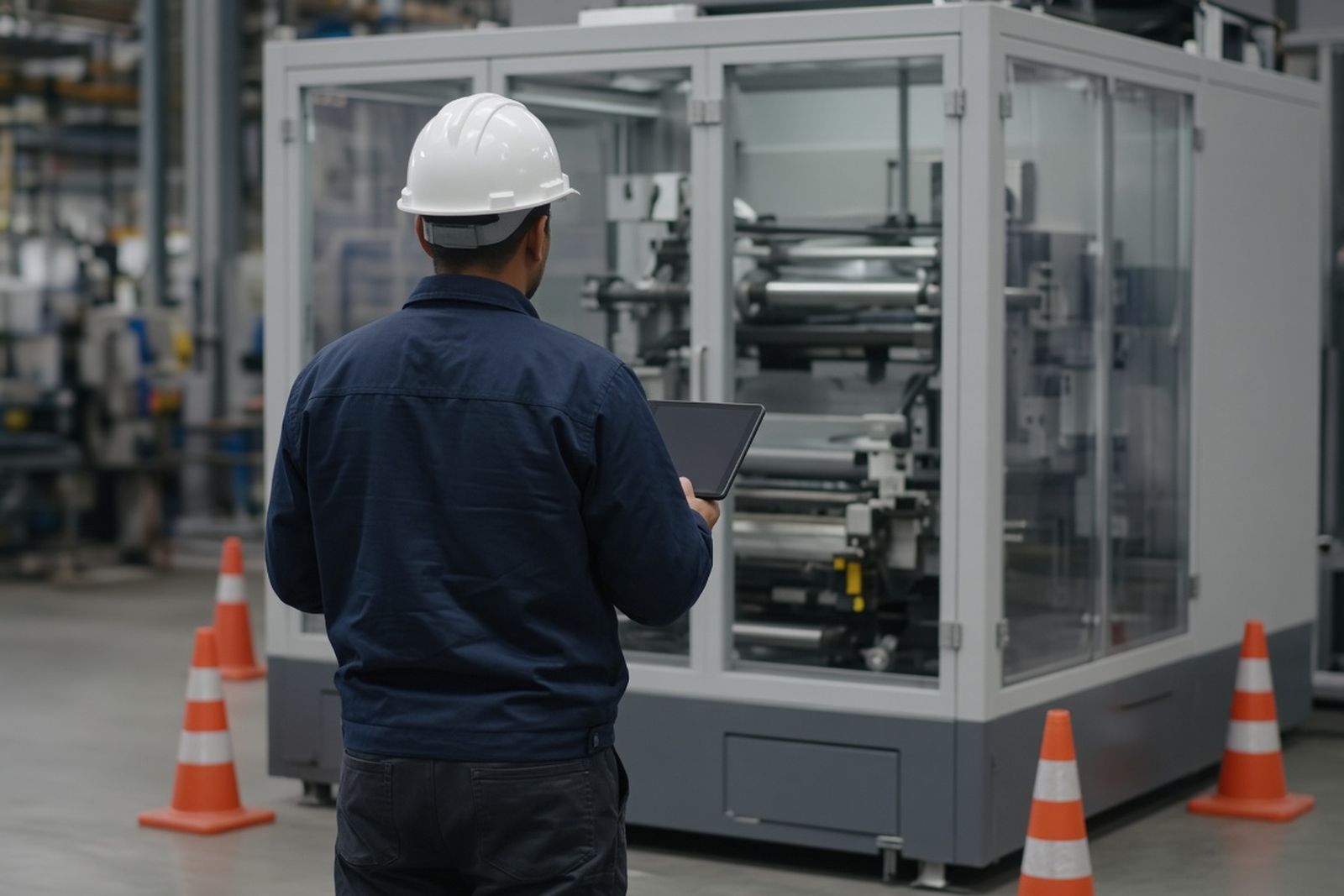
When ATP Testing Helps—and When It Does Not—in Industrial Accident Cleanup
ATP swabs can confirm organic soil is gone from a machine after a workplace injury, but they miss chemicals, oils, and pathogens. Know the limits first.
After an industrial accident, ATP testing can show whether blood and other organic residue were removed from equipment, guards, and floors, and it fits naturally into plants that already use it for sanitation. It cannot detect hydraulic oil, solvents, or specific pathogens, and product residues or porous surfaces can skew readings. Use it as one verification step, with a baseline you set yourself, before restarting equipment.
How to Evaluate Technology Used in Industrial Accident Cleanup
Dry ice blasting, steam, UV-C, electrostatic sprayers, and digital logs all appear in plant cleanup bids. How to judge whether each fits your accident scene.
When a contractor proposes technology for an industrial accident cleanup, judge it by the problem it solves on your equipment, the hazards it introduces, how it interacts with lockout, ignition sources, and food-contact rules, how much waste and downtime it creates, and how its results will be verified. Technology earns its place when it reaches areas hands cannot, not when it replaces careful manual cleaning.
When Enzymes or Microbial Products Fit Industrial Accident Cleanup
Enzyme cleaners lift dried blood from machinery; oil-eating microbes treat soaked soil outdoors. Neither disinfects, and neither suits every plant area.
In industrial accident cleanup, enzymatic cleaners help break down blood and other protein soil on equipment, grating, and textured floors so disinfectants can work. Microbial products, which use live bacteria, are better suited to treating hydrocarbons in soil or maintaining drains and separators. Neither replaces a registered disinfectant, both need time, and live microbes are usually a poor fit near food, pharmaceutical, or other product-contact areas.
Sourced figures on education
- 355,800
Manufacturing reported 355,800 nonfatal injuries and illnesses in 2023, an incidence rate of 2.8 cases per 100 full-time workers.
Read with care: Total recordable cases; only a portion involve bleeding injuries.
Source: BLS (2023)United States private manufacturing, 2023
- 224,450
Exposure to harmful substances or environments produced an annualized 224,450 days-away, restricted or transfer (DART) cases in private industry in 2023-24.
Read with care: Two-year annualized estimate; includes heat, chemical and other exposures.
Source: BLS (2024)United States private industry, 2023-2024 annualized
- 779
Contact with objects and equipment killed 779 U.S. workers in 2023, the second-largest fatal event category after transportation.
Read with care: Includes struck-by, caught-in and crushing events across all sectors, not only industrial plants.
Source: BLS (2023)United States, 2023, all industries
These figures are public research and agency data, not this network's own job records. Keep each number with its population, year and limits; none of them predicts cost, timing or outcome at a specific property.
What research has found
Findings from published studies of people and properties in situations like this one. They describe what researchers observed in a specific group; they are not predictions for your case.
Flushing lowered measured contaminant levels in some homes, but not all.
UK respondents reported greater intended compliance than Polish respondents.
Education: common questions
Why can't a biological spill and a chemical spill be cleaned at the same time?
Some disinfectants react badly with process chemicals. Some chemical cleanup methods leave blood and body soils untouched. Doing the steps in order lets the team identify each hazard and choose products that work safely together. It also lets them pack each waste under the right label. Mixing the two types can create regulated waste that is harder to dispose of properly. A careful plan keeps them apart by area or by step, instead of treating everything with one product.
Is a quick swab test for residue proof that machinery is safe to touch?
No. This is a quick swab test that shows leftover organic residue (it does not detect germs). That makes it a useful check that cleaning removed soil from a spot people touch often. But it does not find specific germs, and it says nothing about chemical residues. Some cleaning products and surface types can also throw off the readings. Treat it as one check among several. Use it alongside a close visual inspection and records showing how long the disinfectant stayed wet. It is not a safety certificate on its own.
What kinds of equipment surfaces are hardest to decontaminate after an incident?
Soft and textured materials tend to be the hardest. These include rubber belts, fabric guards, foam gaskets, and bare wood pallets. Tight gaps around bearings, bolts, and control panels also trap residue. Some parts may need to be taken apart by qualified maintenance staff before they can be cleaned. When a part cannot be cleaned reliably, replacing it is sometimes the safer choice to defend. That decision belongs in the written plan.
Why does degreasing come before disinfection on machinery?
Oil, grease, and coolant form a film. That film shields blood and other body matter from the disinfectant, so the product never reaches what it needs to treat. Removing the film first lets the disinfectant touch the surface directly for the full time on its label. Skipping this step can leave equipment that looks clean but has not been properly disinfected.
How do crews keep disinfectant wet long enough on machinery and vertical plant surfaces?
Each product label lists a contact time. That is how long the disinfectant must stay wet for the product to work as claimed. On upright guards, warm machine housings, and textured steel, the product can run off or dry too soon. Crews may reapply it or choose a product with a shorter listed time. They may also let the equipment cool first. Ask your contractor how they will meet the label time on each surface.
Why is porous concrete so hard to decontaminate?
Concrete has tiny holes and cracks that soak up fluids. The fluid can then sit below the surface, where cleaning tools do not reach. As the concrete dries, residue can wick back up. Sealed or coated floors are easier to clean. But damaged coatings let fluid through. Contractors may clean several times or use extraction machines. In severe cases, they may grind the surface down.
How can I learn more about the products a contractor proposes?
Ask for the product name, the label, and the safety data sheet for each chemical. The label shows what the product is approved to do and how to use it. The safety data sheet explains its hazards, the protective gear needed, and what it should not be mixed with. Your EHS team can check them against chemicals already on site before approving their use.
Related community polls
Every count is a real visitor vote; nothing is seeded or padded. One vote per poll per device, and you can change your answer.
After a serious injury on the floor, what was your hardest early decision?
How did your facility handle cleanup after a serious blood incident?
More on industrial accident cleanup
Industrial Accident Cleanup services
See how workplace injury cleanup, chemical spill response, equipment cleaning, and confined space work are planned and ordered for plants and job sites.
Costs explained
What drives the price, published cost ranges, and how to read a written quote line by line.
Insurance and payment
Which policies may respond, how to document a claim, and what to do if coverage is denied.
Planning tools
Planners and checklists built for facility managers. They cover cost ranges, contractor checks, insurance steps, first-day actions, waste sorting, and in-house risk.
Community polls
Compare your instincts with other operations and safety leaders on scene holds, restart pressure, choosing a contractor, and supporting affected workers.
Knowledge quiz
Test what you know about spotting hazards, scene control, sealing off areas, disinfecting, waste paths, and records before an accident puts it to use.