Short answer
A defensible industrial accident cleanup scope starts with the facts of the event and any scene holds, then defines lockout responsibilities, work zones, mixed contaminants, products, waste streams, verification, and the handoff back to production. The hypothetical press injury below shows how an EHS manager and a remediation contractor might write that scope so that investigators, insurers, and employees can later see exactly what was done.
Why a single cleanup deserves a formal scope
After a serious injury, the pressure to restart production is real. A supervisor may want the area scrubbed by the end of the shift so the line can run in the morning. Skipping the planning step feels efficient, but it often produces gaps: an energy source nobody locked, oily absorbent thrown in with biohazard bags, or a drain that nobody checked.
A written scope is the antidote. It captures what happened, what the contractor will do, what the plant will do, how waste will be handled, and how everyone will know the job is finished. It becomes part of the incident file alongside the investigation and any regulatory correspondence.
The walk-through below is fictional from start to finish. The plant, the employees, and the event are invented to illustrate a process. None of it should be read as describing what a regulation requires at your site.
The incident on the press line
Imagine a mid-sized metal stamping plant that produces brackets for the appliance industry. On second shift, an operator on a hydraulic press reaches into the die area to reposition a part. The press cycles, and the operator suffers a serious hand injury. In the same moment, a hydraulic hose near the ram ruptures and sprays fluid across the bolster, the floor, and a nearby parts bin.
Coworkers hit the emergency stop and call for help. A trained first-aid responder controls bleeding until paramedics arrive, and the operator is taken to the hospital and admitted. Blood is present on the die, the press controls, the floor around the press, the first-aid responder's route to the breakroom sink, and a hand truck used to move a parts bin out of the way.
The plant's EHS manager reports the hospitalization to OSHA as required and asks whether the area must be preserved. The area office asks for photographs and says the press should remain as is until an inspector reviews it. The next day, the area is released for cleanup.
The intake conversation
The EHS manager calls the plant's contracted remediation company. Before scheduling a crew, the company's project manager asks a series of questions and records the answers. That record becomes page one of the scope.
Asking these questions before anyone arrives means the crew shows up with appropriate PPE, absorbents, and products, and the plant has already arranged the people it needs to supply.
- Has the area been formally released, and by whom?
- Which energy sources feed the press, including hydraulic, electrical, pneumatic, and gravity from the ram?
- What fluids were released, and do you have safety data sheets for them?
- Which surfaces and objects have visible blood, and which have oil, and which have both?
- Did anything reach floor drains, trench drains, or a pit?
- Were any porous items contaminated, such as cardboard, wood pallets, or rags?
- Who from the plant will control lockout and sign off on restart?
Dividing lockout and roles
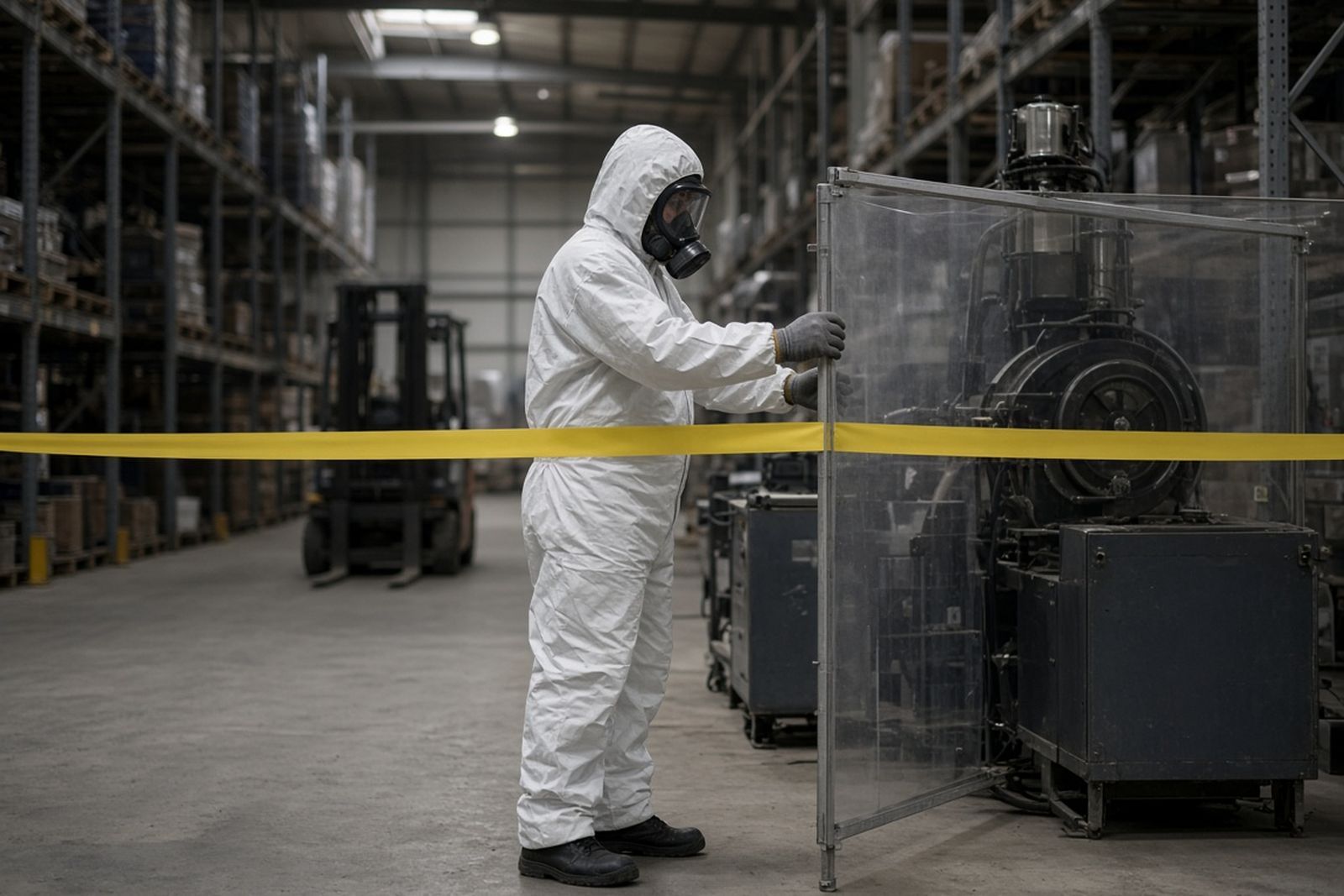
In this hypothetical, the scope states that the plant's authorized maintenance employee will apply locks to the press main disconnect, the hydraulic power unit, and the pneumatic supply, and will block the ram mechanically. The remediation crew lead will apply a personal lock to the group lockbox before any crew member works within the press envelope.
The scope also draws clear lines. The contractor will clean and disinfect. Plant maintenance will remove and replace the ruptured hose, reinstall any guards removed for access, and perform functional checks. The contractor will not adjust, repair, or operate equipment.
Why so much detail? Because lockout gaps during cleanup are a known risk. The Safety+Health summary of OSHA data for fiscal 2024 shows that Machine Guarding (1910.212) drew 1,541 OSHA citations, tenth on the most-cited list. A scope that names who controls energy and guards leaves less room for assumptions.
Mapping work zones and contaminants
The project manager divides the area into four zones. Zone A is the press itself: die, bolster, ram face, light curtain housings, and controls. Zone B is the floor within a marked radius of the press, including the drain grate. Zone C is the route from the press to the breakroom, including a door push plate and the sink. Zone D is mobile items: the hand truck, the parts bin, and the first-aid kit that was opened.
For each zone, the scope identifies the contaminant mix. Zone A has blood and hydraulic fluid together. Zone B has pooled hydraulic fluid with blood mixed in near the press. Zone C has blood only. Zone D varies by item.
That mapping drives everything else. Where oil and blood are mixed, the crew must remove oil first with absorbents and a degreaser, because a disinfectant applied over an oily film will not reach the surface underneath. Where only blood is present, the sequence is clean, then disinfect.
The breakroom route in Zone C deserves a note of its own. Contamination carried away from the machine is easy to overlook, because the people cleaning naturally focus on where the injury happened. Door hardware, a sink faucet, and a paper towel dispenser touched by a responder's gloved hand can be missed entirely unless someone walks the route and writes it down.
Products, waste streams, and the floor drain
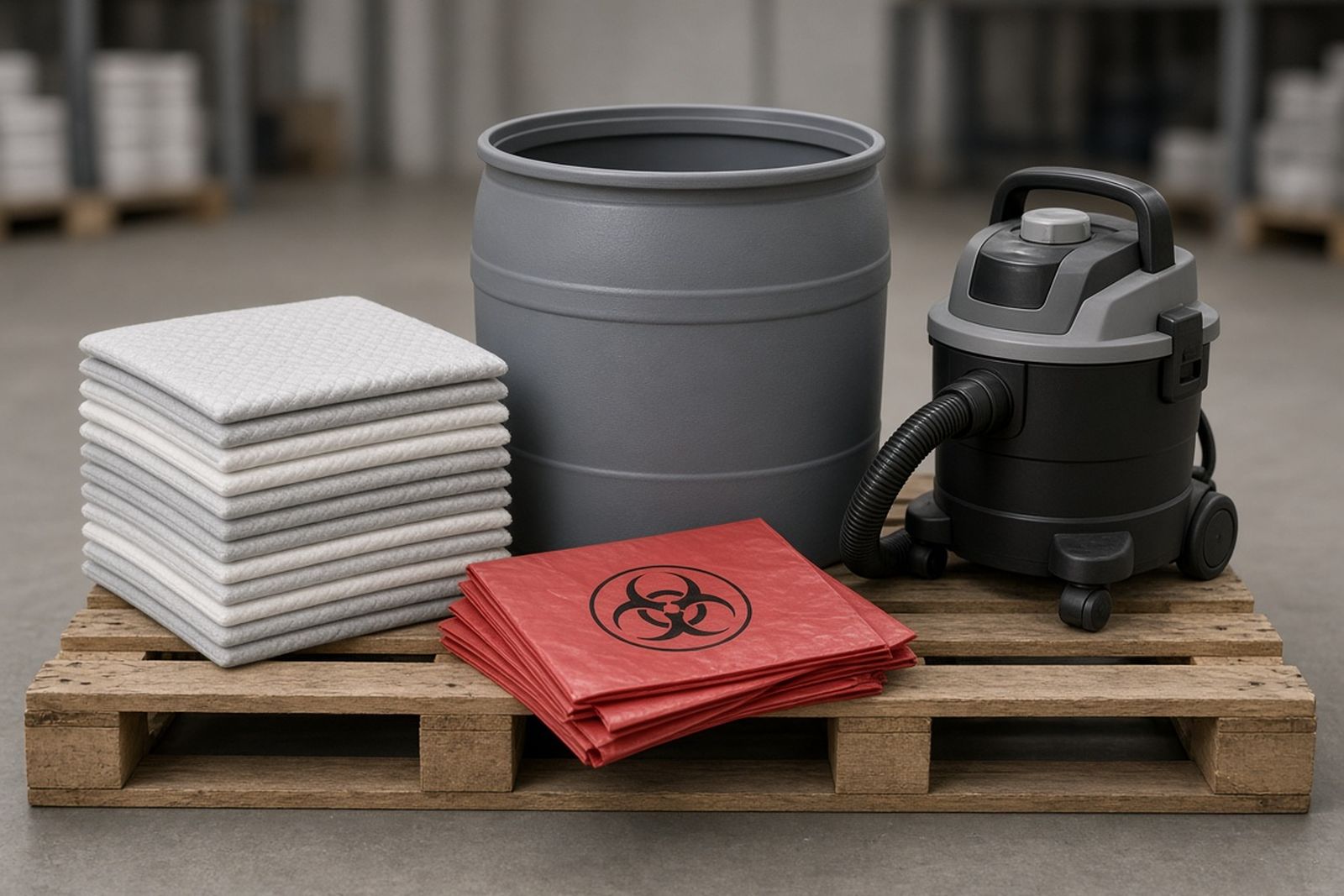
The scope lists each product: an absorbent for bulk oil, a degreaser compatible with the plant's hydraulic fluid, a detergent for general soil removal, and a registered disinfectant appropriate for bloodborne pathogens. Each product's safety data sheet is attached, and the plant's EHS manager confirms that none react poorly with the hydraulic fluid or the press finishes. The label contact time for the disinfectant is written into the scope.
Waste is split into streams. Absorbent and rags with oil only go into the plant's existing oily waste program. Items with blood go into regulated medical waste containers. Items with both are the tricky category; the scope states that the EHS manager and the contractor will jointly determine how to classify and package mixed waste based on the state environmental agency's requirements and the waste hauler's acceptance criteria.
The cardboard parts dividers in the contaminated bin are porous and soaked, so the scope calls for disposal rather than cleaning. The metal bin itself will be cleaned and disinfected.
A floor drain sits about two meters from the press. The plant's drawings show it connects to an oil-water separator before the sanitary sewer. Even so, the scope does not rely on that separator to handle the event.
The crew places a drain cover before starting work, removes the grate, and cleans the grate and the accessible drain body. Plant maintenance arranges for the separator to be inspected and, if needed, pumped by its regular service vendor. Those records are added to the file.
If the drain had led to a storm system, the EHS manager would have needed to consider environmental notification requirements. That question is always worth asking early.
Verification and handback to production
The scope defines verification before work starts. First, a joint visual inspection by the crew lead and the EHS manager, using portable lights, covering all four zones. Second, a record showing the disinfectant was applied and kept wet for its labeled contact time in each blood-affected zone. Third, photographs of each zone before and after cleaning from the same angles.
After verification, the contractor removes its personal lock and signs its section of the closeout. Maintenance replaces the hose, reinstalls guards, and performs its checks. Only then do the production manager, the EHS manager, and maintenance jointly authorize restart.
The closeout package gathers the intake record, the zone map, lockout records, product list with safety data sheets, before-and-after photographs, waste receipts for each stream, the separator service record, and signatures from each party. It is filed with the incident investigation so that anyone reviewing the event later sees the cleanup and the root-cause work together.
The plant also reviews the event itself. Manufacturing is not a low-risk sector: the BLS reported that manufacturing recorded 391 fatal occupational injuries in the United States in 2023. In this hypothetical, the investigation leads to changes in how operators reposition parts and how often hydraulic hoses are inspected.
What can your plant borrow from this example?
You can turn this process into a template now, before you need it. Pre-fill your standard lockout points for major equipment, the waste streams your plant already manages, your drain map, and your preferred products. When an event happens, the EHS lead fills in facts and zones instead of starting from scratch.
Keep people in mind too. The first-aid responder, the coworkers who hit the stop, and the operators who return to that press will all carry the memory of the event. Offer access to your employee assistance program, and consider asking whether anyone would prefer not to be on that line for the first few shifts after restart.